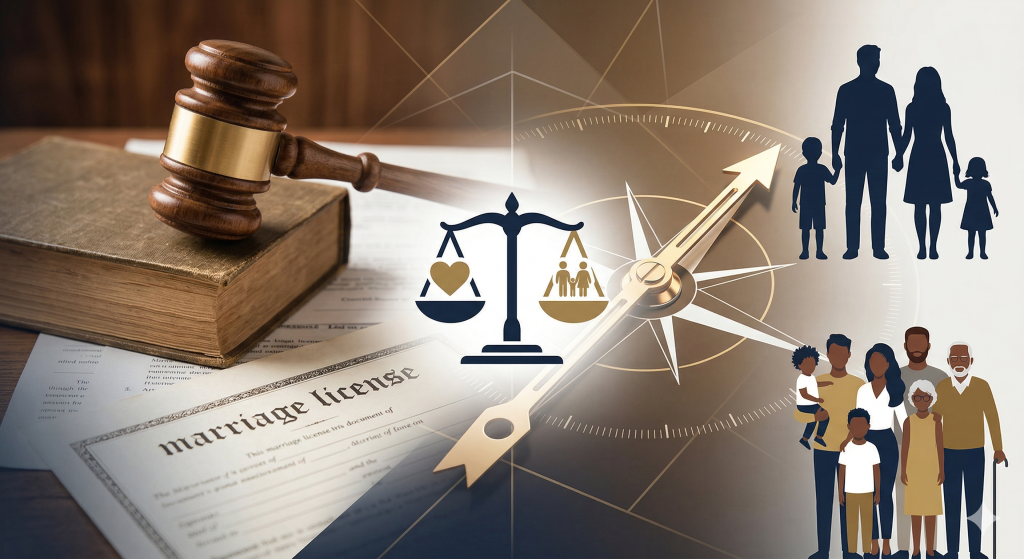
I recently had the privilege of joining Groot FM to discuss the latest statistics surrounding the rise of divorce and the decline of formal marriages. This decline is not a new trend—it has been steady since 2016—but the reasons behind it are not singular. Modern families are increasingly structured outside the bounds of traditional marriage, opting instead for permanent life partnerships. We naturally see more ‘blended families’ as well.
With the rise of modern familiar structures, two critical questions have come to the forefront:
- What are the legal consequences when a life partnership dissolves?
- What maintenance obligations do step-parents face regarding their step-children?
Recent judgments have placed these questions firmly in the spotlight.
Life Partnerships: Moving Beyond ‘Legal Strangers’
Historically, our common law established an automatic reciprocal maintenance obligation solely for spouses in formalized marriages. This left financially dependent partners in permanent life partnerships legally destitute upon dissolution, as no legal duty to support existed.
This stance is changing significantly:
- The Bwanya Precedent (2021): The Constitutional Court found that a reciprocal duty of support can be established in permanent life partnerships, expanding the definition of “spouse” in the Maintenance of Surviving Spouses Act.
- The EW v VH Distinctions (2023): While the Court was cautious to expand the common law broadly in this specific matter, as it found that it had already been done in Bwanya, it highlighted that the success of such claims is highly dependent on the facts of the case and best suited to be adjudicated by a trial court. In this matter, the majority judgment found that the Applicant failed to substantiate her claim for interim relief.
- The PAL v RJT Judgment (2024): In a landmark move, the Court granted interim financial relief (pendente lite) to a partner in a permanent life partnership. The Court found that if an Applicant can substantiate a prima facie claim of a reciprocal duty of support, interim relief is a necessary remedy. This does not mean a final duty to support though, and this must still be dealt with by the trial court.
While the legislature continues to develop the Domestic Partnership Bill, the Courts are clearly beginning to acknowledge that a reciprocal duty of support can arise from the reality of how a couple lives, not just a marriage certificate.
Step-Parents and Step-Children: The Best Interests of the Child
A more controversial judgment was delivered in March 2026 in the matter of NTM v BEM. Here, the Court alluded that a step-parent can incur a maintenance obligation toward step-children. It is important to note that this was a Rule 43 – interim relief – judgment.
The Context:
Under the Children’s Act, an automatic maintenance obligation exists only between biological parents and their children. Step-parents do not automatically obtain these rights or responsibilities, thus no maintenance obligation towards step children establishes. However, in reality, many step-parents assume a full parental role, both emotionally and financially.
The Ruling:
In this matter, a well-off step-father had “showered” his step-children with luxuries and paid for certain expenses directly. He assumed a real parental role. When the relationship ended, he substantially decreased his financial support. The Court disagreed with this sudden withdrawal, basing its finding on the “best interests of the child.”
The Court ordered interim relief for the payment of maintenance to the Applicant, payment of medical expenses and payment of certain former joint expenses. The Court however did not grant maintenance for the children directly, although their expenses were taken into account and they will benefit from the payment of the joint expenses. The judgment did not establish a final duty to support the children by the step parent. This still needs to be decided by the trial court.
A Balanced Conclusion
While the judgments regarding maintenance claims in permanent life partnerships are welcomed, the judgment on maintenance obligations of step parents should be approached with caution.
- Permanent Life Partnerships: The common law duty to support is a vital remedy, but the existence of a permanent partnership and that a legal duty to support established, must still be proven by the Applicant.
- Step-Parent Obligations: This should not be taken lightly. We must protect the best interests of children, but we must also be careful not to negate the primary responsibility of biological parents. However, where a step-parent has assumed a parental role, the law may hold them accountable for that commitment.
Modern family structures are complex, and dissolving them requires a path that is both fair and justified.
Please note:The information provided above is intended only to offer a basic overview of the topic and does not constitute comprehensive legal advice or a full discussion of all relevant procedures. For more detailed information or personalized advice specific to your situation, please contact us to schedule a consultation.