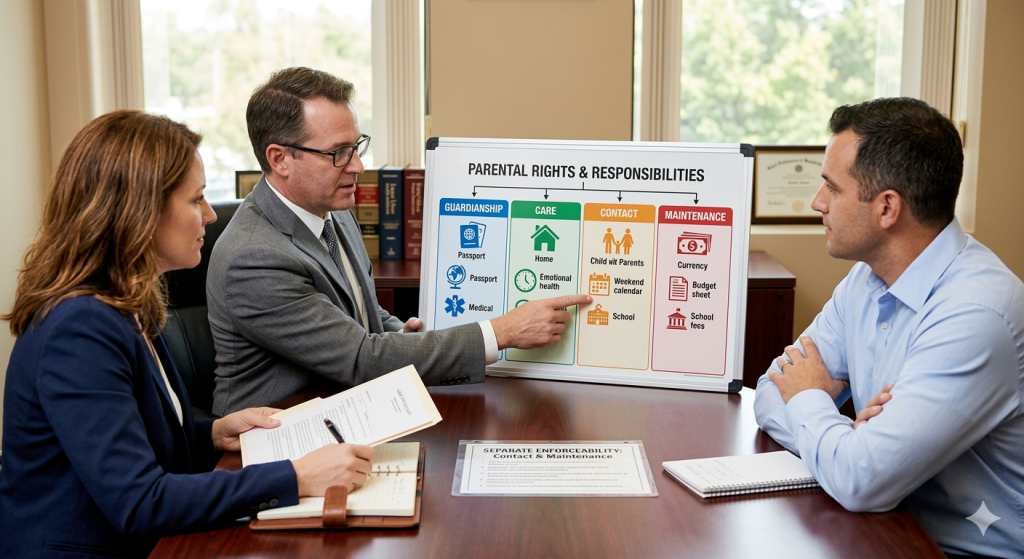
In practice, I still frequently encounter clients under the misguided impression that contact with children can be “set off” against maintenance payments, or vice versa.
It is vital to understand that whether you frustrate contact (without legal justification) or fail to pay maintenance, your actions are unlawful and can carry severe legal consequences. Simply put: Contact cannot be withheld if maintenance is not paid, and maintenance cannot be withheld if contact is frustrated.
Here is a short overview of what you need to know about contact vs maintenance:
The Four Parental Rights and Responsibilities:
Under the Children’s Act, there are four parental rights and responsibilities:
- Guardianship
- Care
- Contact
- Maintenance
Parents as Co-Holders:
Both parents remain co-holders of full parental rights and responsibilities. During a divorce—or in cases where parents were never married—these rights need to be defined to regulate the co-parenting relationship post-separation. All arrangements are strictly subject to the best interests of the child and are bespoke to each unique family dynamic.
Guardianship
Only a High Court or Children’s Court can terminate or limit a parent’s guardianship, upon application. Guardianship entails the right and responsibility to be a decision-maker in a child’s status, schooling, and medical care.
Crucially, joint consent from both guardians is required for specific major life events, including:
- Applying for a child’s passport.
- For a child to travel abroad.
- Major medical procedures.
- Psychological or psychiatric assessments and therapy.
Care
Both parents have a responsibility to care for their children physically, emotionally, and mentally. Primary care and residence refers to the parent with whom the child primarily lives, subject to specified contact rights afforded to the non-resident parent.
While there is a growing movement supporting shared primary care (where children spend equal time with both parents), this arrangement is subject to very strict conditions to ensure it serves the child’s best interests, and not every jurisdiction is in favour of same.
Contact
While the Children’s Act defines contact as a parental right, case law has extended this to clarify that contact is the right of the child and the responsibility of the parent.
Contact is designed to ensure the child maintains a healthy, strong relationship with both parents. This is not a “one-size-fits-all” arrangement; it typically includes weekend and holiday schedules, special days, and the right (and responsibility) to attend the child’s school, sporting, and cultural activities.
Maintenance
Both parents are obligated to provide financial support, though this is almost never a 50/50 split. Per the Maintenance Act, we first establish the financial needs of the child and then assess each parent’s ability to contribute.
Contributions are calculated pro-rata based on each parent’s financial means. Maintenance can also be structured creatively; it does not always require cash contributions only to the other parent and can include direct payments to service providers such as school fees or medical expenses.
Moving Forward
These parental rights and responsibilities are meant to be exercised in conjunction with one another, yet they are enforceable independently. While the relationship between spouses may end, the parenting relationship does not. Resolving parental disputes is essentially a restructuring of the family unit post-separation, and when parents exercise their responsibilities healthily, the children are the ultimate beneficiaries.
Please note:The information provided above is intended only to offer a basic overview of the topic and does not constitute comprehensive legal advice or a full discussion of all relevant procedures. For more detailed information or personalized advice specific to your situation, please contact us to schedule a consultation.